
By John Jefferson
We once spent a night at my grandmother’s house on the Guadalupe River. During my youth years, I was there several weeks or more every summer, trudging up and down the riverbank with a cane pole and a can of worms or other harvested fish bait.
We arrived after dark, not planning to fish. Next morning, after seeing that beautiful river, our plans abruptly changed. But not having any worms, I knocked down a yellow jacket’s nest for bait. The larvae are a delicacy to perch.
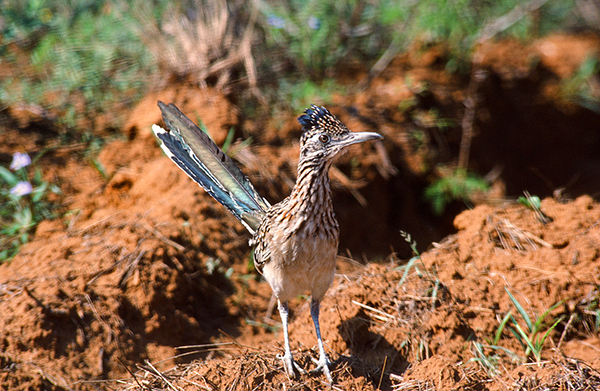
Sitting by the slough, fishing in a place I had practically homesteaded years earlier, a kid came up with his pet. It was a roadrunner – the closest I would ever get to one.
It wasn’t on a leash; it just followed its master wherever he went. But it met a new friend that morning. As sociable as its master, it came closer, watching me pluck larvae out of the nest with my knife. The kid said, “I think he wants a bite.”
Not really believing that, I had a larvae on the tip of my knife. The roadrunner nabbed it instantly. And that was the end of our fishing. The “wild roadrunner” stood right beside me within petting distance as it grabbed all our bait as I fetched it with my knife. When it took the last one, it looked me in the eye as if to say, “Is that all you got.?” I’d give money to have a picture of that!
Roadrunners are protected by state and federal law. Contact Texas Parks & Wildlife with questions. The one mentioned above followed the kid voluntarily and snitched food without being touched.
Years later, after I had become obsessed with photographing wildlife, I spent almost an hour trying to photograph another roadrunner. As I approached its comfort zone, the bird would go around to the other side of a cedar clump. When I moved to the other side, it would go back to where this dance began. It seemed to become a game.
Scientifically, roadrunners are classified in the coocoo family. That one made ME coocoo!
That roadrunner had more patience than I had. It was a hot day and I finally gave up, realizing how the comic “Wile E. Coyote” must have felt.
Time passed, and a photographer friend from Idaho came for his first visit to Texas. We had lunch at Canyon of the Eagles overlooking Lake Buchanan. Afterwards, as we walked to my truck, a roadrunner appeared among the cactus and granite rocks. It struck a pose and held it, since we were a safe distance away from it with telephoto lenses with motion reducing features.
The other photographer probably returned to Idaho telling friends how easy it was to take good wildlife pictures in Texas. But LUCK, however, plays a major role.
In photographing roadrunners – as it is with most wildlife – the rule of “F-8 and Be There” applies.
They don’t usually come to you … unless you have their favorite food!
JJ