

Since I’m in the woods a lot, I’m occasionally asked if I’m afraid of snakes. My usual answer is, I respect them.
Avoiding their likely habitats — rock piles, brush piles, cactus clumps, and tall grass — is wise. Nature has countless obstacles, along with the delightful pleasure of just being out in it. Snakes are part of it. I accept that and avoid blundering through it without regard for snake habitats. That’s like sticking your hand in fire and not expecting to get burned.
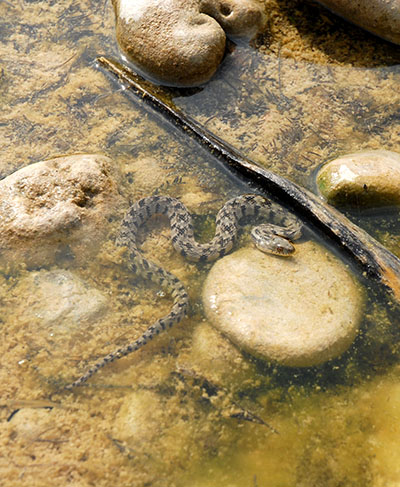
A “diamond-back water snake,” a common, non-venomous but occasionally aggressive reptile, if threatened. They are usually in water, but also inhabit shoreline grass, and can bite. They’re a threat to fish on a stringer and will sometimes hold their position. If bitten by any snake, seek medical attention quickly, but calmly, taking identifying evidence of the snake with you. If unsure of identity and time permits, Google for pictures. (Photo by John Jefferson)
Rattlesnakes inhabit almost all of Texas. Cottonmouth water moccasins are usually in and around all waterbodies. Copperheads may be the most dangerous since they are easily camouflaged in dry leaves or pine needles, have potent venom, and are easily stepped on or sat upon.
They also account for the most snake bites in Texas. For more information, see my snakebite article in the March 2025 issue of the Texas Wildlife Association magazine — Texas Wildlife.
A female turkey hunter once told me she answered Nature’s Call in the pre-dawn darkness before settling into her turkey blind. She felt something sharp, thinking it was a limb on the ground. Later, in the shower, she screamed when the hot water hit her backside. She had probably been bitten by a copperhead. Tissue sloughed off for six months.
Coral snakes, with their red and yellow bands touching, are seldom seen and aren’t as aggressive as Texas’ other venomous snakes. But their powerful venom can be deadly. They’ll move away as you approach, if given the chance.
If bitten by any snake, seek medical attention at once — but calmly! And don’t waste time attempting any outdated and useless first aid treatments like cutting/sucking/spitting or applying ice. Just GO Quickly!!
A med student working in a small clinic in southeast Texas while attending medical school was told a man came in saying he had been snake bitten. He brought the reptile for identification. The “doc” asked where it was. The man lifted his forearm which was wrapped tightly with a towel and said, “All I could do was wrap it hurriedly with my other arm before it got away.”
That caused some excitement until the “doc,” who was a hunter, declared it a non-poisonous water snake. The man was treated for infection and released.
My eldest son lived in a fashionable neighborhood in old West Austin. He discovered a huge snake in his garage with its head by one stud and its tail by another. He recognized it as a rat snake and measured the distance between the two studs. The snake was six feet long. He wisely shooed it away unharmed.
Rat snakes are one of the most beneficial snakes in Texas. They help control rats and mice. Big ones are among the most frightening to encounter.
They can turn up anywhere — even in old, established neighborhoods — especially when hungry. If in doubt whether a snake is venomous, treat all as poisonous, and head for medical help if bitten.
JJ