

by John Jefferson
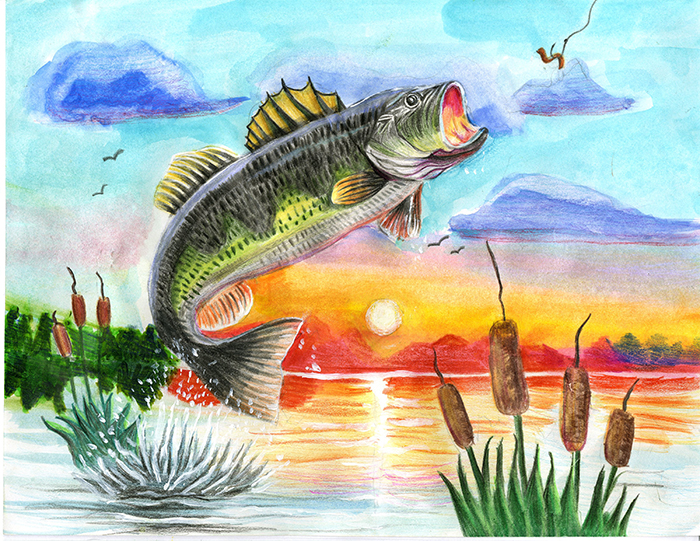
The winning artist in the grades 4-6 category was Candace Chen, from Bee Cave, Texas. She painted the bass that’s pictured. Educators and parents can find entry forms, rules, guidelines, and the deadline for the next contest when they are published on Texas Fish Art Contest – TPWD site. The recent contest’s winning works are on the 2026 Fish Art Contest Album on the TPW Flicker page. (Photo Copyright Texas Parks and Wildlife Department)
Lots of people all over the world fish. The actual number of anglers – sport and professionals — is anyone’s guess but mine is that it’s a least a gazillion or two.
People waiting their turn to launch a boat just before daylight all over Texas tell me at least half of that number are in line ahead of them. Suffice it to say that it’s at least a bunch. And twice that many are probably telling someone somewhere about the biggest fish they ever caught – Anglers love to talk about fishing experiences.
And a much smaller number of kids each year have entered drawings or paintings of fish in the Texas Parks & Wildlife Department’s (TPWD) annual Fish Art Contest. According to last week’s TPWD press release, last year’s contest drew 714 students between kindergarten age and twelfth grade.
Contest judging is done separately for the K-3 age group for the “Mighty Minnow Award. Grades 4-6, grades 7-9, and 10-12 grade students are all also judged separately. Others may wish they had entered. The contest is administered by the Texas Freshwater Fisheries Center (TFFC) in Athens. It is part of the national Wildlife Forever’s Fish Art Contest.
Scholarships are awarded to winners of each age bracket and range from $100 for Kindergartners to $1,000 for age 10-12 winners. Second and third place winners also receive scholarships. Invested at compound interest, all are significant starters for college funds. Fourteen entries will also be featured in the Texas Fish Art Calendar and displayed at the TFFC.
The Fish Art Contest was developed to connect students with the outdoors and interest them in fish, fishing, and fisheries. It’s a wholesome way to grow up safely and learn the benefits of being off the couch and onto the lakes, streams, and into the woods. Entrants into the contest also are required to include a short essay about the fish species they are featuring.
I hope the students are as turned on to going fishing after researching and writing about their fish as I usually am when I write about fishing!
My mind wander to so many great times I’ve had fishing in waters in Texas, a number of other states, in Canada, Mexico, and Argentina. It opened the door to travel and meeting new friends in places I might not have been to were it not for fishing.
There was no such contest as I was growing up – not that I would have entered. I couldn’t even draw water — until I learned to prime the pump! Some, like me, needed a fishing pole and some tackle and someone to teach me how to fish. Parks and Wildlife has a fishing tackle loaner program to eliminate that lacka-tackle drawback. Google the TPWD website.
If youngsters need someone to show them the ropes – or lines — parents or relatives can help if they fish. If they don’t feel qualified, their friends can usually find a willing mentor through sportsmen’s clubs, churches, neighbors, or Game Wardens and other TPWD fisheries employees.
JJ