
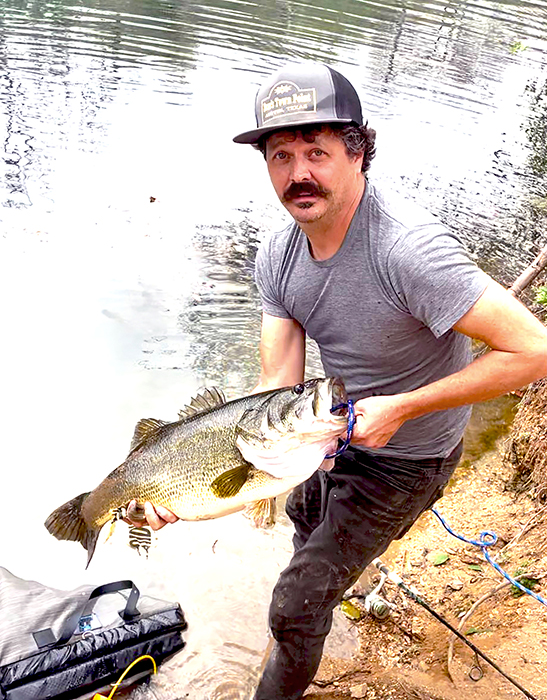
Willie Pipkin with his 14.05-pound ShareLunker illustrates several things: One is that anglers don’t need an expensive boat – or even a boat at all – to catch a ShareLunker. Although he has a boat, Pipkin walked the bank of Barton Creek in Austin and caught the fish from shoreline. The other is that a ShareLunker can come from a waterbody that has never produced a13-pound bass before. Pipkin walked along the bank on Barton Creek and caught the new lake record for Lady Bird Lake. Barton Creek is a tributary of Lady Bird Lake. (Photo by Tim Fading)
by John Jefferson
Happy New Year! it’s a week late, but records show few fish bite the first January week.
The new Toyota/TPWD ShareLunker season opened the same day! The season for entering a 13-pound bass or larger runs January 1 to March 31, each year.
The program is 40-years old. The closing date was moved up several years ago to end on March 31. That ensures that bass being entered survive the trip from the lake where it was caught to Athens. As spring weather begins to warm, bass could become stressed on a longer trip. But why take it to Athens?
Well, that’s where the hatchery is located where fish being loaned by successful anglers are taken for breeding. Anglers aren’t required to loan their bass to TPWD, but I’ve never heard of one declining the opportunity. The bass’ eggs are fertilized there by a ShareLunker male bass and their offspring restocked into Texas waters. The loaned female bass is usually returned to the lake where caught, and the angler invited to accompany TPWD employees and release his fish. Special prizes are given the loaning angler.
Anglers should call the Hatchery office at (903) 681-0550, 24/7, for pick-up. An Inland Fisheries employee will leave Athens at once to pick up the fish in a special truck with an aerated holding tank developed just for hauling fish — getting them to their destination in good condition.
Some of the offspring from the arranged “piscatorial marriage” are usually released into the lake where the mama bass was caught. The rest of the herd is stocked in public lakes throughout Texas. These bass are then called “Lone Star Bass” and have helped Texas achieve the status of being a world-class bass fishing destination. Did it work?
In 1986, when the ShareLunker Program began, an eight-pound bass’ picture would have made the newspapers. A lady named “Ethel” changed all that. Actually, she was unnamed until her notoriety demanded a name.
A Lake Fork guide, Mark Stevenson, wrangled her into his boat on November 26, of ’86. He had cast a jig with a craw worm trailer and reeled in the first entry into the new Toyota TPWD ShareLunker program. She weighed just under 18 pounds. Ethel was loaned to the affable Johnny Morris and his Bass Pro Shops in Missouri for display in their aquarium. Morris claims over 20 million people viewed her. She became the poster fish for catch-and-release, weighing 20 pounds at her death. She was 19.
About a year later, Ethel’s Texas largemouth record was broken by my friend, Barry St. Clair. Barry’s record (18.18 pounds) still stands. For now.
Anglers catching and entering a 13-pounder and loaning it to TPWD receive a whale of tackle, a “13+” decal for their truck or boat, a custom mount of their fish, entry into two Bass Pro Shops drawing for $5,000 shopping sprees, and a boat load of fame. See the TPWD website for entry rules.
And their “roommates” probably cease questioning their going fishing anymore!
JJ