
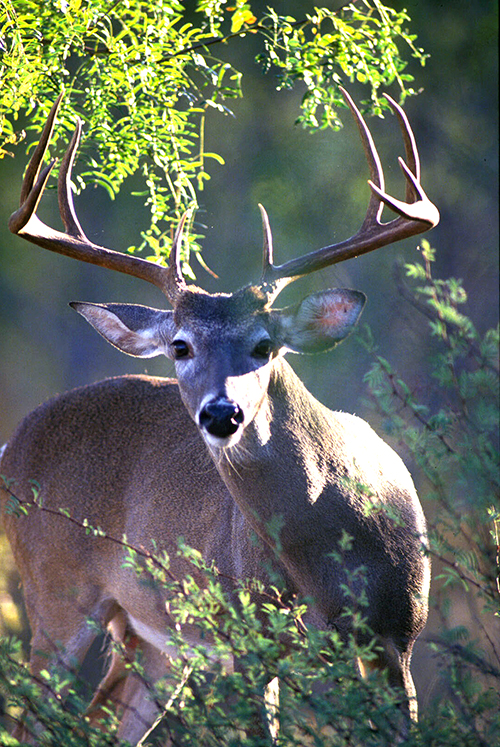
Hunters sought bucks similar to the one pictured and tagged 425,529 bucks comprising 51% of the total 2024 harvest. They also took 411,480 does (49% of the total harvest).
(Photo by John Jefferson)
by John Jefferson
White-tailed deer season opens Saturday morning, Nov.1, at 30 minutes before sunrise in both the North and South Zones. The North Zone closes on Jan. 4; South Zone on Jan. 18. Check your local sunrise time — especially if it’s cloudy and you can’t see the sunrise! Guesses don’t count!
And check the Texas Outdoor Annual (online) for the county in which you hunt. Some have special regulations, like antler restrictions.
Texas has diverse habitats. Some benefitted from adequate rainfall during the springtime start of the antler-growing period. Others missed a jump start at growing the best antlers possible. Every region, however, can produce decent antlers.
Overall, Texas Parks and Wildlife Department’s (TPWD) White-tailed Deer Program Leader, Blaise Korzekwa, prepared a lengthy and informative whitetail forecast and prefaced it by saying “Another great (deer) season is expected.” Hunter success in 2024 was 67%.
Many variables affect antler growth. Weather is extremely important. Some Texas areas received adequate rainfall, leading to nutritious plant production that fed bucks’ antler production. Deer age is also important. Four-and-a-half-year-old bucks and older are considered mature.
Mature deer are treasured trophies by most hunters.
Regions with adequate spring rainfall earlier this year were the Cross Timbers, Pineywoods, and Post Oak Savannah. The Edwards Plateau and South Texas stayed dry.
Fawn crop size five years earlier indicates the current size of the older segment of the buck population, and the amount of opportunities available for harvest in any given year. Much of Texas will host a number of trophy possibilities.
Good fawn crops for 11 years have survived to increase Texas deer population to five million whitetails. The downside to that is that buck harvest has exceeded the doe harvest, allowing the females to increase to a ratio of 3.7 does/buck – the highest in two decades. I wrote about that a few weeks ago, and hunters know what to do.
Looking at particular regions, the Edwards Plateau (Hill Country) has the most deer (1.6 million). Severe drought has hurt it. Mason and Llano counties still have the most deer. There are also opportunities for older bucks between Hondo and Del Rio and north of Highway 90.
South Texas is still the premier big buck region. Hunter success was 78%. Portions of deep South Texas received good rains, but much of the region will be average. (Although “average” in the Brush Country is terrific to most hunters.)
The Post Oak Savannah should be productive along I-10 from San Antonio to Houston. The northern portion received good rains. Hunter success was 64 %.
Pineywoods offers another good year, with 40 % of harvested bucks being 4.5 years old. Antler restrictions have helped.
Cross Timbers has the second largest deer population with good buck distribution throughout all ages. Expect an above-average mature buck harvest.
Eastern and Western Rolling Plains had over 70% hunter success and Western RP had the 2nd highest harvest of 6.5 age buck, second only to South Texas.
It looks like another great Texas deer season!
JJ