

by John Jefferson
Summer is vacation time.
Perhaps you’ll include some fishing on it. Maybe a freshwater trip or a salty water vacation? Or both?
Texas has 361 miles of coastal shoreline and bays from Port Arthur’s Sabine Lake to Brownsville and Port Mansfield — including Baffin Bay (the big trout bay). That includes Laguna Madre and North and South Padre Island.
If some of your family isn’t as interested in fishing as they could be, Galveston, Port Aransas, Corpus Christi, and South Padre Island offer sunlit beaches and surf to splash in, as well as seaside shopping and seafood restaurants galore.
Spotted sea trout (speckled trout) and red drum (redfish) are the most popular surf or bay species caught. Bait shops supply live or dead shrimp. An aerated bait bucket helps keep shrimp alive.
Despite my sounding like a chamber of commerce come-on for their city, the Gulf Coast helps put Texas in a small class of states that offer ocean, mountains, major league sports attractions, historic sites, big city shopping, excellent saltwater and freshwater fishing, and its own brand of local charm within a day’s drive of each other. Texas is in a class by itself. The late Coach Bum Phillips defined a “class by itself” as one in which it doesn’t take long to call the role.
That’s Texas.
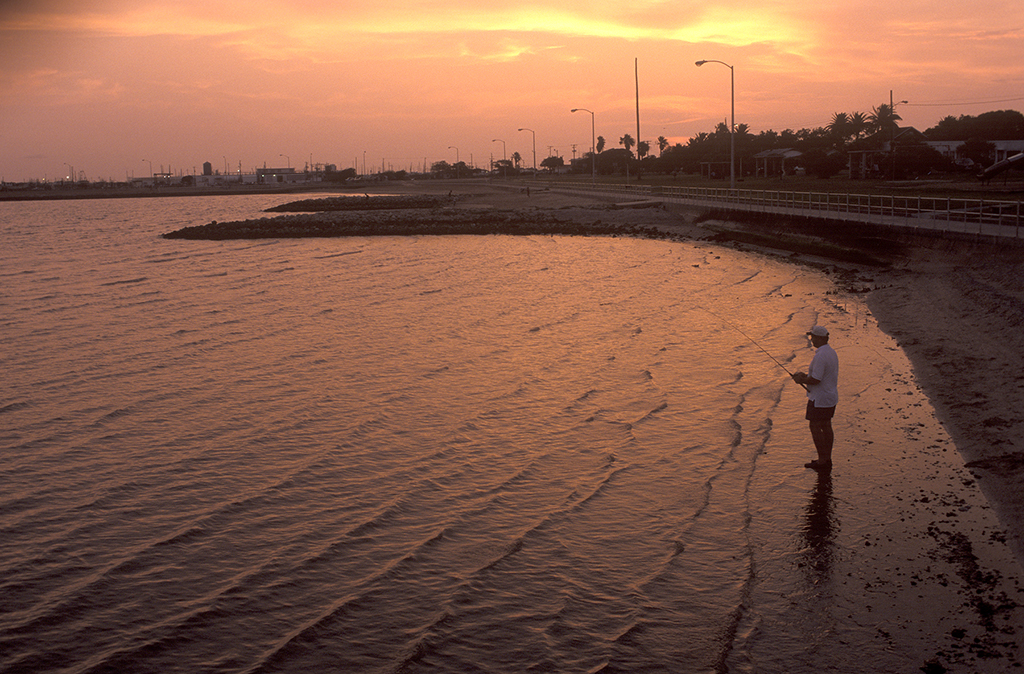
A solidary angler fishes Tres Palacious Bay on a quiet weekday evening. Fishing licenses are required of anyone fishing except those under age 17 or born before Jan. 1, 1931. The Texas Outdoor Annual online contains fishing rules and bag limits for freshwater and saltwater.
(Photo by John Jefferson)
Texas also has abundant freshwater fishing. Even West Texas has a few scattered waterbodies in a usually arid landscape. Most states lack as many miles of rivers and creeks as Texas. Lakes Fork and O.H. Ivie have attracted out of state big bass anglers along with hordes of Texan to those two waterbodies that have produced so many trophy largemouth bass– leading Texas lakes.
But 79 other Texas lakes have also produced “Legacy Class ShareLunkers” weighing 13-pounds or more. A new lake joins that list practically every year. So, pick a lake – any lake — and it could have big bass in it. Or, if you’re just interested in having fun catching fish of any size, just choose one and have at it.
Bass will strike any number of artificial lures or live minnows, available in most bait shops. Live or recently deceased grasshoppers, crickets, or other insects, are excellent choices, too. Wasp or yellow jacket larvae also work well, provided you can knock down a nest from under the eaves and run like a rabbit until the flying ones drift away.
Popular artificial lures are “Speed Craws,” “Rat-L-Traps,” and the zillion kinds of plastic worms. There are too many lures to name, but tackle shop employees can steer you to the latest “hot lure.”
When using small artificial lures, earthworms or any of the insect baits mentioned, you’re likely to also catch catfish or sunfish. Beware of the catfish’s fins; they can stick ya! Sunfish the size of the palm of your hand are excellent eating, as are catfish.
Just remember using sunscreen — and avoid wading too deep into the Gulf. That could put YOU into the food chain.
JJ