

by John Jefferson
I’ve only repeated a column subject once — when new hunting regulations took two weeks to cover them all!
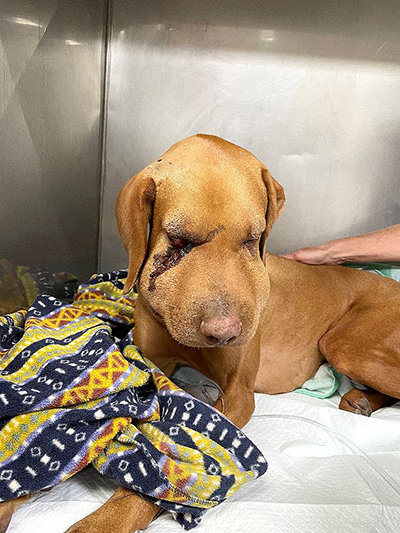
My nephew, Mark Boyt, told me about his Vizsla getting bitten on their ranch. Dogs curiously lead with their noses to determine what things smell like. “Rollie” lost facial tissue, lost some sight in one eye, and nearly died. We’ve taken our last six dogs to Snake Avoidance clinics, and none have been bitten on ranches they’ve visited with us. We’ve seen its effectiveness once, and the absence of snakebites on thousands of acres speaks volumes. (Photo courtesy of Mark Boyt)
But after rereading last week’s column, I realized I had underplayed the danger snakes present. One newspaper employee shrieked “Ewww… snakes.” Some people don’t want to think about snakes, but we all should. We either move into their environment, or they venture into ours.
I have grandchildren and great-grandchildren that live and visit relatives in prime snake habitats. The last venomous snake I killed was a cottonmouth that nested between their house and the creek. I gladly risked the rath of “snake protectors” in order to remove the danger to two precious grandkids.
In last week’s column, I did stress that non-venomous snakes shouldn’t be harmed. I know, however, of too many tragic accounts of kids and venomous snakes. This follow-up will be blunt — maybe with a little of the hair left on, as Western writers often say.
Texas has four venomous snake species and most of them have venom that is hemotoxic – it attacks tissue and destroys red blood cells. The Mohave Rattlesnake, found in the Big Bend area, has venom that is neurotoxic. It attacks the nervous system, and a bite can lead to paralysis and extreme breathing difficulty. It is considered 50 times more dangerous than hemotoxic venom. Immediate medical treatment is imperative!
Coral snakes, found in the eastern half of Texas, have similar venom, but seldom bite humans due to their mouth’s structure and biting difficulty.
Most rattlesnake’s, cottonmouth’s and copperhead’s bites can be successfully treated with antivenom if applied QUICKLY. It’s highly advisable to keep the phone numbers handy for the nearest medical facility AND veterinarian to verify adequate supplies of antivenom.
Valuable time can be lost if a bite victim is transported to a facility lacking antivenom.
A friend told me of a three-year-old child in their family being fatally bitten by a rattlesnake in Austin’s Angus Valley subdivision when the area was first developed. Children are more susceptible to severe damage due to their size.
Another incident, told me by a veterinarian, involved a young kid getting bitten early one morning as he stepped off the porch in the dark to join his father. Snakes often live under houses. He was bitten on his upper body. His parents immediately embarked toward the nearest hospital which was 30-40 miles away. The little guy died in his mother’s arms enroute. I understand she was deeply troubled by it from then on.
Snakebites aren’t restricted to children. A healthy guide/friend on a ranch I photographed on was severely bitten and confined to the Laredo hospital for weeks. I never saw him again.
As a high school classmate climbed out a swimming hole, a cottonmouth bit him multiple times. He almost died … and lost a year of school.
He lived; but probably never swam in rice field waters again.
Beware where you walk. Avoid brushy or rocky areas. Always carry a flashlight after dark.
JJ