
by John Jefferson
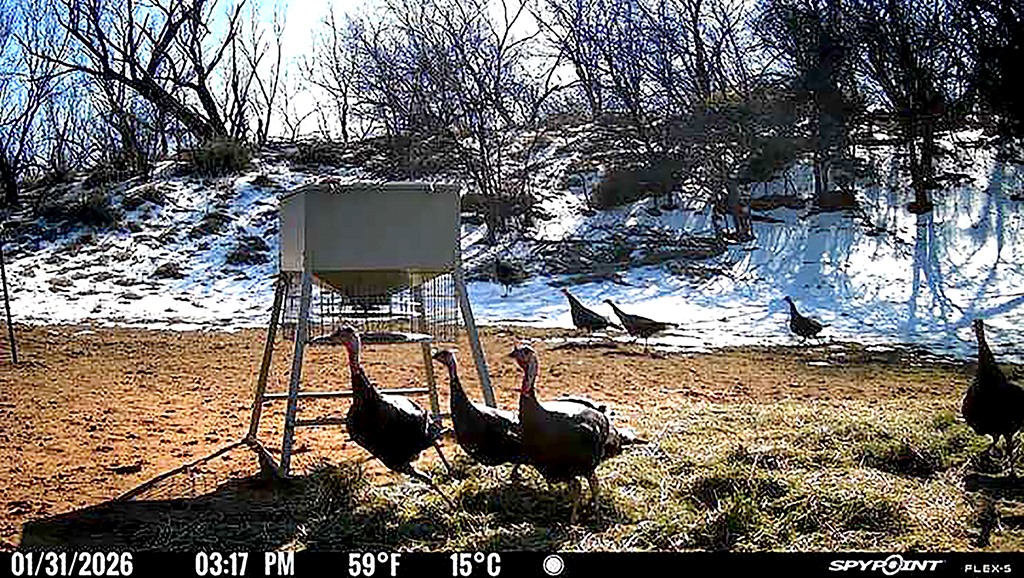
The attached photo might make turkey hunters rethink their hunting attire.
The February picture was taken near Roby, in Texas’ North Turkey Zone. A rancher/friend sent it.
Snow isn’t forecast for the rest of Texas until possibly February 2027. But In 1980, the Y.O. Ranch west of Kerrville checked weather history and scheduled its 100th anniversary party on the second weekend in March, making sure freezing weather was over. Charlie (Four) Schreiner told me though guests were dancing in a four-inch snow!
Hunters are probably safe this year. Spring wild turkey season doesn’t open this year until March 14 in the South Zone; March 28 in the North Zone. Youth Seasons, however, are open March 7-8 in the South Zone; March 21-22 in the North Zone.
One-bird Bag Limit Counties open April 1-30. The Eastern Zone opens April 22-May 14. Checking the Texas Outdoor Annual for the county you hunt is mandatory!
Much of Texas is dry, but TPWD says after rain, grasses and wildflowers appear. Breeding soon follows. Last year was the THIRD year in a row of good turkey production and turkey biologists like Jason Hardin, TPW Wild Turkey Program Leader, say to expect to see an abundance of two and three- year-old gobblers on the range.
In fact, the large gobbler population may cause gobblers hunting hens to show up in areas not seen before. Give ‘em a call. And don’t be intimated by people at sporting shows in turkey calling contests.
My late friend, Horace Gore, was one of the most experienced turkey hunters in Texas. He took turkey hunting so seriously that he stopped on the trail once to listen to what might have been a distant gobble — or perhaps a hen clucking nearby. He was so still he didn’t feel the rattlesnake that struck his boot three times!
It hadn’t rattled. Some rattlers don’t before silently striking. Not wanting to scare the turkey he had heard, Gore kicked the snake off his boot and continued slipping down the trail. He told me once that even the most amateur could call turkeys successfully with a box call or a slate and a striker, and a little practice.
He also said camouflage and the ability to remain motionless were more important than calling perfection.
I hosted an expert turkey hunter from the northeast once, hunting east of Evant. I placed him, chose my hunting place, and began calling. I later asked him if he had heard my calls, and how they sounded. He answered, “At first, I thought I was hearing a turkey hen!”
I prefer a slate but know highly successful turkey hunters who prefer box calls and/or mouth calls. Calling one spring morning west of Lampasas, I was surprised when a turkey flew in on my first call. Then I saw it was a HEN! Sitting still while about to sneeze nearly choked me. But I decided she was an unexpected live decoy!
It’s one of the greatest sports. Give it a try!
JJ