
by John Jefferson
One fall, we were late leaving Austin on our way to lead a photo workshop in Colorado as the aspen leaves change from green to gold. That’s such a rare time of year.
The longest part of the trip was just getting out of Texas. We were enjoying the drive together but weren’t paying attention to time. Driving past miles of Texas Panhandle grain fields and rolling pastures, we had passed all the usual campsites. We realized too late that we were in barren country north of a place to camp for the night.
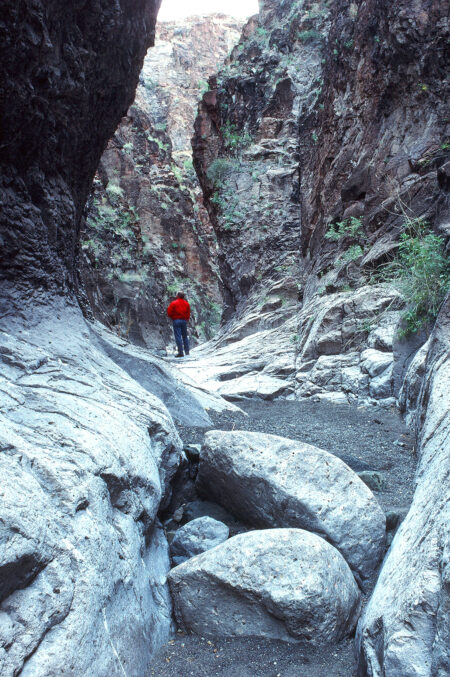
“Closed Canyon” in the Big Bend Ranch State Park (pictured) is unique in that its 200-foot-high walls and ten-foot width give it another world feeling. Sunlight seldom intrudes. No sounds are heard from outside the towering walls, creating a surreal sense of silence. The distant image of a solitary hiker wearing red intensifies the desolate diorama. (Photo by John Jefferson)
Vicky scanned the map, then replied: “The only campground I see is in the Oklahoma Panhandle called Black Mesa State Park.” By that time, we were racing darkness. Black Mesa seemed our only choice.
The park office was closed. We found a likely campsite under a tree and parked the van there beside Carrizo Creek.
The next morning, I went to the park office to pay and asked if there was a shorter way to Colorado than backtracking into Texas. The attendant directed us into Kenton, Oklahoma and to a road (Oklahoma # 325) toward New Mexico. He cautioned that it was a rough, unpaved road, but would be quicker than returning to Texas.
He was right. It was rough. But about 15 minutes on it, unusual rock formations rose up unexpectedly from the prairie.
Vicky said, “We must have missed the turn; I think we’re in Arizona!” The uplifts were suggestive of Monument Valley, only smaller. Nothing on the map mentioned them.
I wanted to take pictures but was unsure how long it would take to get to Colorado – assuming that washboard road would get us there. So, we drove on.
We’ve talked about that deserted road many times since. Sometimes an unexpected road change may be a blessing. It probably saved us an hour or more and we got to Colorado on time, but the missed photo opportunities are still regretted. It would have only taken 1/ 50th of a second to take a picture. Sometimes it costs hundreds of dollars in expenses to get to a place fate would only allow us one visit. New Mexico‘s Dakota Sandstone rocks were an example.
Some readers probably have similar stories. Those missed moments are almost a compacted view of life. It passes us quickly and is gone before our eyes like a fading sunset over a mountain lake at dusk.
Many of our images are once in a lifetime shots. I’m grateful for having recorded many — like the immaculate Hill Country buck that pinned his ears back as if to charge me, lying ten feet away in the weeds with a camera. Or Vicky standing on a Big Bend hillside, silhouetted against last light.
When you’re fortunate enough to see a unique shot after being taken down a trail you hadn’t intended to travel –TAKE IT! You may never see it again.
That 1/50th of a second could save you a lifetime of regrets.
JJ