
by John Jefferson
When I initiated this column in 2017, I wrote that in addition to game and fish population data, unusual wildlife sightings — like whooping cranes, ocelots, bears, and doe deer with antlers — the column would occasionally include rare attractions outdoor enthusiasts need to know about. This column tells of one such unique venue.
I was alerted to it by Dr. Jerry Cooke, Former Texas Parks and Wildlife Department Big Game Program Leader. Cooke, who is himself somewhat rare, has retired to second careers in various art forms, in addition to being a knowledgeable wildlife authority. His art includes oils and watercolors, drawings, sculpture, jewelry, and creating Native American attire. He himself is of Choctaw decent. He even constructed his own teepee for camping.
Cooke now lives in a charming hilltop home just outside Kerrville and alerted me to an exhibit of large wildlife photographs, some the size of those in a multi-mural Texas collection I once produced for a client. I wanted to see the work in the Kerrville exhibition.
Rachel Spencer was the photographer. Most of her work is from the West, and Alaska: elk, grizzly bears, Bisons, deer, and others. The largest – a telephoto image of a snarling grizzly — was taken from about a hundred – foot distance. A park ranger with a rifle stood behind her, just in case.
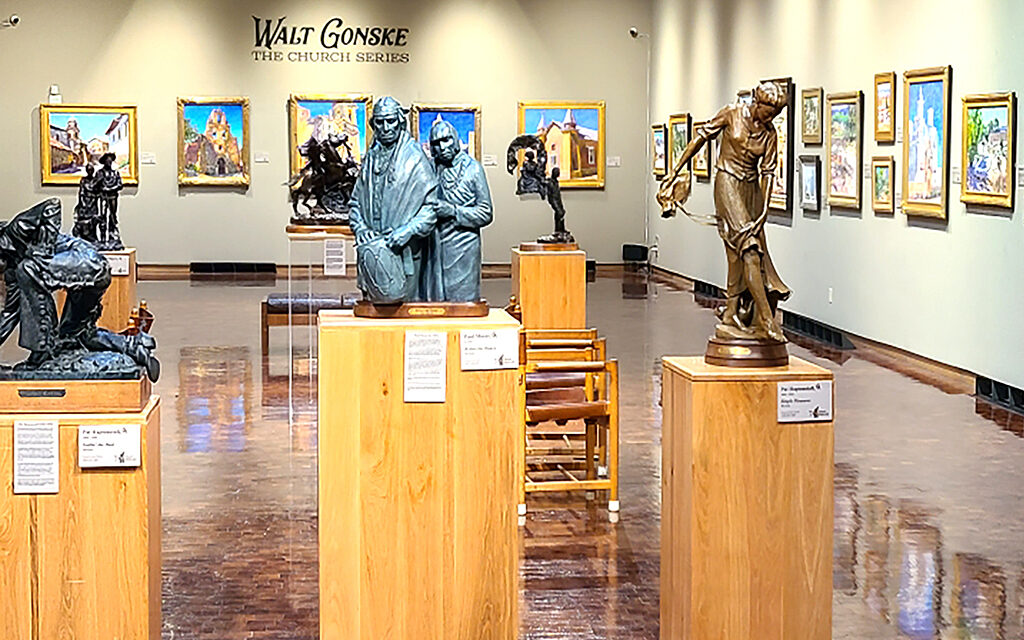
I’m glad we went. The exhibit at the Museum of Western Art in Kerrville was worth the drive but has now been taken down according to the Museum’s normal exhibit timetable. I appreciated her work but was also impressed by the Museum’s permanent exhibits. Anyone interested in the West and its culture and inhabitants – both native and recent – will be enthralled.
One needn’t be an art aficionado to enjoy it. If you don’t know much about art, but appreciate the West, you’ll probably be glad you went.
Located on a famous trail that cowhands once drove cattle on from Texas to Dodge City and other markets, the 14,000-foot gallery and adjoining large outdoor sculpture exhibit offers a visual experience of life as it was… and is.
Cooke accompanied me through the exhibit. One black and white image caught my eye. To me, the image appeared to be a photograph shot on sharp pre-digital Plus-X film or modern equivalent of a cowboy holding a rifle and warily looking away. The detail in it was sharply defined. Sensing my thinking it was photograph, Cooke politely said, “Hard to believe that was a charcoal rendering.” I was shocked.
The detail was immaculately sharp. Another by the same artist depicted a saddle, and I could almost smell the leather!
The Museum displays pieces by prominent modern artists including G. Harvey and a few old masters like Charles M. Russell.
The week after I was there, the highly regarded True West Magazine announced that The Museum of Western Art had been named the Number One Western Art Museum in America! And it’s not far down the trail from you!
So, saddle up!
JJ