
by John Jefferson
Well, it’s not real velvet, but every year about August and September, most white-tailed buck deer have thick-appearing antlers covered with a hairy substance somewhat resembling tan velvet.
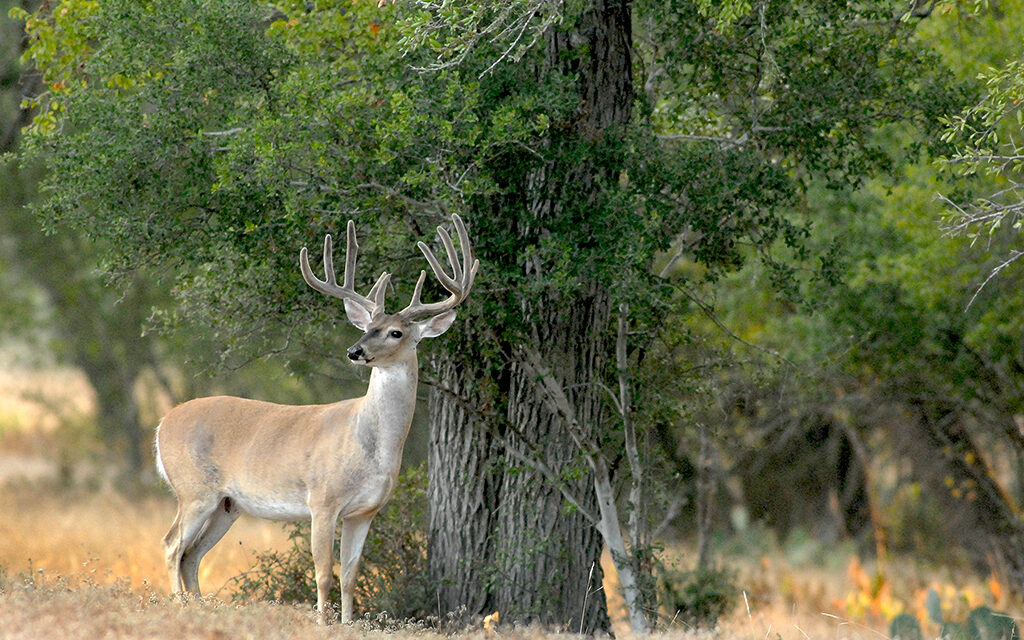
I received a photo recently of a buck in velvet from my friend Willie Krecek who owns a ranch near Roby in West Texas. Velvet antlered deer photos are somewhat rare since bucks are only in noticeable velvet for a short time before they scrape it off in September to reveal polished antlers.
To understand velvet antlers, one must first understand antlers in general. I read the explanation a New York female Ph.D. wrote in White-tailed Deer – Ecology and Management, my favorite wildlife reference book. She used lots of words to say antlers are used to establish their position in the herd for sex and dominance.
She also said they make a deer a challenging adversary when faced with predation by humans. I wish I had read that before I untangled a young eight-point buck from a barbed wire fence west of Ingram, Texas in 1963.
I was there to help – not to fight. When I finally got him loose, he thanked me by hooking me in the upper thigh before running off. He just didn’t understand. But the next time I found a deer entangled in barbed wire; I called for a biologist with a tranquilizer syringe. Whitetails have occasionally been known to kill humans – usually during their rutting (mating) season.
Their antlers are designed to be weapons of combat in the frequent quest for mates. That often leads to death for one or both combatants.
Their first set of antlers begins growing during a bucks yearling spring and summer. Size is influenced by age, nutrition, and genetics, although there are differing schools of thought about the practicality, expense, and necessity of genetic manipulation.
As summer progresses, the growing antler bones contain blood vessels and nerves and become covered by a hairy skin called “velvet”, by the authors of the reference book mentioned above and most hunters. I don’t know who first used the term to apply it to deer antlers, but I can’t think of a more fitting one.
When the antler bones become hardened, the velvet begins to slough off. That usually occurs in September. Deer help the removal process along by rubbing against bushes or small trees. I had a unique photo studio on a hill overlooking several miles of rolling, wooded hills right at the edge of Austin. There was a wet-weather creek Iin the valley below. I advertised my business as the only photo studio in Austin with a buck rub in the front yard. Deer nearly shredded a young tree by rubbing it each September!
It must feel good to deer to rub off velvet. A young buck approached me in a state park once and tried to rub velvet against my leg. In self-defense, I broke off a weed and began switching its antlers. The look on its face became one of contentment.
JJ